

Sometimes you do not want a complex slot with a dozen bonus screens, but a simple, fair, and fast game where all the excitement is concentrated in one movement. That is exactly how Plinko Rush feels — an arcade slot in the format of falling balls, where you adjust the risk, bet size, and board height, and then simply watch where the multiplier lands. The game is created by Betsoft and since 2024 has quickly become popular among players from the USA, who value clear rules and transparent math. Thanks to the combination of customizable risk, neat RTP, and a maximum win of up to x888 of the bet, Plinko Rush gives not only a show but also real potential for bright results.
Basic information for players from the USA 🇺🇸
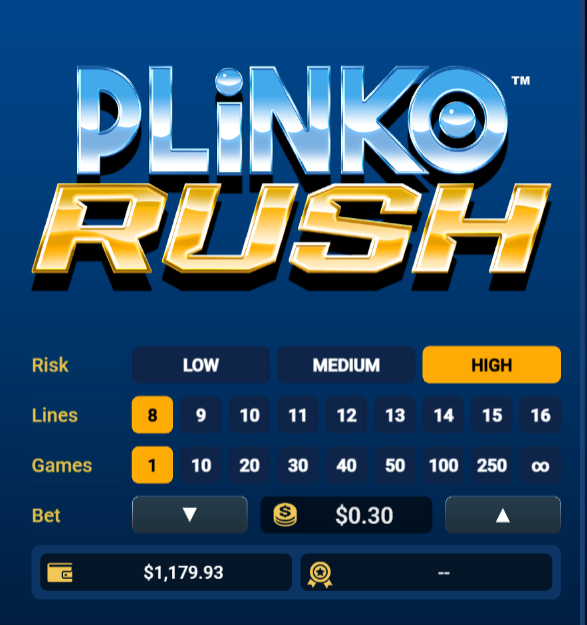
Plinko Rush is not a classic reel video slot, but an arcade ball drop game: you drop a ball at the top of a pyramidal board, it bounces off pegs, and finally falls into one of the pockets with a multiplier. The player pre-selects the bet size in US dollars, the number of rows (usually from 8 to 16), and the risk level: low, medium, or high. These parameters determine not only the “depth of the fall” of the ball, but also the distribution of multipliers — somewhere the range is softer, somewhere extreme values appear.
From a mathematical point of view, the game runs on RTP of about 95.7–96.27% depending on the version and settings, which corresponds to the average market level and gives a fairly fair return over distance. An important plus for the US audience is the flexible bet range: most operators offer amounts from $0.10 to $100 per ball, so you can play with light bets or more boldly. With a properly set bankroll, Plinko Rush turns into a controlled experiment with probabilities, not chaotic randomness. It is convenient to look at Plinko Rush through a set of basic numbers that help to understand how well the game fits your style.
Visual style, sound, and overall game experience 🌌
In terms of visuals, Plinko Rush feels like a modern arcade with a cosmic twist: dark blue background, metallic shine of the board, and brightly highlighted pockets with multipliers. Colors are chosen so that even during long sessions the image does not tire the eyes — soft shades of blue and yellow dominate, without an aggressive neon palette. The balls move smoothly, and the bounce physics looks realistic enough so that there is no feeling of being “rigged for show.”
The sound design supports the atmosphere: light background music resembles a sci-fi arcade, and at the moment the ball falls the focus shifts to short effects of hits on the pegs and the final click in the pocket. Against this UX solution, the interface remains minimalist: on the left and right are the bet, risk, and row count settings, and just below — the autoplay control and the number of balls. For players from the USA, this interface is intuitive: all important elements are visible at once, without extra nested menus and confusing buttons.
Gameplay mechanics 🔧
The core idea is simple: you set the round parameters, press the button, and then just watch the ball bounce off the pegs toward the final multiplier. However, under this simple picture lies fairly flexible math. The choice of the number of rows sets the length of the path: 8 lines is a shorter and more predictable descent, 16 is a long and more chaotic one, with an expanded range of multipliers.
Adjustable risk is another key element. At low risk, pockets with losses or minimal multipliers appear less often, but the maximum values are more modest. At high risk, the board becomes “sharper”: there are more pockets with multipliers below 1×, but on the edges those very large x-values appear, which adrenaline lovers come here for. Plus, you can choose whether to drop one ball, run a series of drops, or turn on autoplay and watch dozens of balls rush down simultaneously.
How the Plinko board and multipliers work 📊
To better understand what happens with each ball drop, it helps to imagine the board as a grid of probabilities. Each peg sets a potential turn to the right or left, and the final position at the bottom is tied to a specific multiplier. At low risk, the central pockets are usually filled with multipliers close to x1–x2, and the side ones with rarer values like x5–x9. At medium risk the spread widens, and at high risk pockets capable of boosting the win up to x888 appear.
The number of rows also affects the density of these values: a short board gives fewer steps and a more compact range, a long board gives more random bounces and, as a result, more chances to land both in a strong plus and in a minus. It is important that Plinko Rush honestly shows you the entire field of multipliers in advance — you see which values are located at the bottom even before the drop. This makes the game transparent: you understand which pockets you are hoping for and what risk you are taking.
How to start playing in the USA
Before dropping balls, it is better to build a simple and clear entry scenario. For players from the USA, it is important not only to choose a comfortable bet in dollars, but also to immediately set limits for time and budget. As an arcade game, Plinko Rush is very fast, so “extra” clicks can imperceptibly turn into dozens of rounds. It is better to decide in advance how much you are ready to spend in one session and how many minutes you are ready to devote to the game.
After that, you can move on to the board settings. In most versions you choose the number of rows, the risk level, and the game format: single drops, a series of balls, or autoplay. It is important not to rush here: each slider affects the character of the game, and a few minutes of experiments in demo mode will quickly help you find a comfortable setup. When the basic scenario is clear, you can move on to real bets without changing settings every two rounds.
Strategies, tips, and player types 💡
Although Plinko Rush is a game of pure chance, you can still look at it strategically. The player’s influence is concentrated not at the moment the ball falls, but in setting parameters before the click: risk, number of rows, bet size, and number of simultaneous drops. For the US audience, used to fast and bright arcades, it is especially important not to turn the game into random button mashing. It is better to decide in advance what the goal of the session is: to test the mechanics, to catch several large multipliers, or just to spend 15–20 minutes in a relaxed mode.
At low risk, Plinko Rush resembles a leisurely walk down the board: balls more often land in pockets with multipliers around 1×, and the balance behaves relatively evenly. Medium risk already gives noticeable peaks and drawdowns, and high risk turns each drop into a mini lottery, where some balls clearly go into the red, but individual hits can cover an entire series of attempts. It is important to understand that no strategy cancels the role of probability, and the player’s task is to choose a comfortable level of fluctuations.
💡 Strategies, tips, and player types
- ⭐ Goal-oriented player. Sets a clear objective before starting (testing mechanics, hunting multipliers, or relaxed play) and adjusts risk and rows accordingly.
- ⭐ Low-risk explorer. Uses small bets, low risk, and fewer rows to keep balance swings smooth and sessions longer.
- ⭐ Balanced strategist. Chooses medium risk, experiments with different board sizes, and watches volatility without pushing the bankroll.
- ⭐ High-risk thrill seeker. Accepts sharp drawdowns, plays with higher risk and multiple drops, and aims for rare but powerful multipliers.
- ⭐ Disciplined short-session player. Limits playtime to 15–20 minutes, avoids endless autoplay, and treats each series of drops as a separate test.
Who Plinko Rush is suitable for: ratings and play scenarios 🎰
Plinko Rush is good in that it allows you to tune the game to different styles: from a calm casual format to aggressive series with high risk. At the same time, the rules remain equally simple for everyone: you choose parameters, click, and watch where the ball lands. This makes the game attractive both for beginners and for experienced users who are already tired of overloaded video slots.
US players often like the format of short but emotionally intense sessions, and fits perfectly into this scenario. You can arrange a 10–15 minute Plinko break between tasks or plan a longer series of drops in the evening without spending time studying complicated rule tables. At the same time, risk customization allows you to choose a comfortable stress level: some will stay in low mode, others will mix medium and high, hunting for maximum x888.
Pros and cons for the US audience ✅❌
Like any fair game, Plinko Rush has a combination of strengths and weaknesses. On the one hand, it offers a very transparent mechanic: you see the board, multipliers, risk level, and understand that the result depends only on the trajectory of the ball. This is a pleasant contrast to confusing slots where the player has to remember how exactly the next super feature works. On the other hand, the straightforward format may seem too simple to someone, especially if you are used to long storytelling slots.
Short lists of pros and cons 

✅ Pros
- Simple and transparent mechanics: all multipliers and risk settings are visible before the round starts.
- Flexible customization — 8–16 rows, multiple risk levels, and a wide USD bet range.
- Modern visuals, smooth animation, and strong mobile optimization for any device.
❌ Cons
- The game is fully luck-based: no skill elements beyond choosing settings.
- The lack of classic slot features (reels, wilds, free spins) may disappoint traditional slot fans.
Plinko Rush is a carefully designed arcade slot that focuses not on a complex story, but on pure dynamics and control of the risk level. For players from the USA its main advantage is a clear structure: you see the board, multipliers, set parameters, and immediately understand what is happening on the screen. Adjustable volatility, RTP at the industry standard level, and a maximum multiplier up to x888 allow you to consider the game a serious alternative to many regular slots.
FAQ ❓
Can you play from a phone in the USA?
Yes, the game was originally developed with a focus on mobile compatibility, so it works correctly in browsers on smartphones and tablets on iOS and Android, while maintaining smooth animation and convenient controls.
Which risk level is better for a beginner?
Beginners are usually more comfortable starting with low or medium risk at an average number of rows (for example, 10–12), in order to first see how the balance behaves and how often different multipliers appear, and only then try higher settings.
Does it make sense to focus on the maximum x888 when choosing a strategy?
The maximum multiplier x888 rather shows the ceiling of the game’s potential than something you should count on in every session, so it is more reasonable to build expectations around stable, controlled gameplay and to treat big hits as a pleasant but rare bonus.